
No clip currently needed
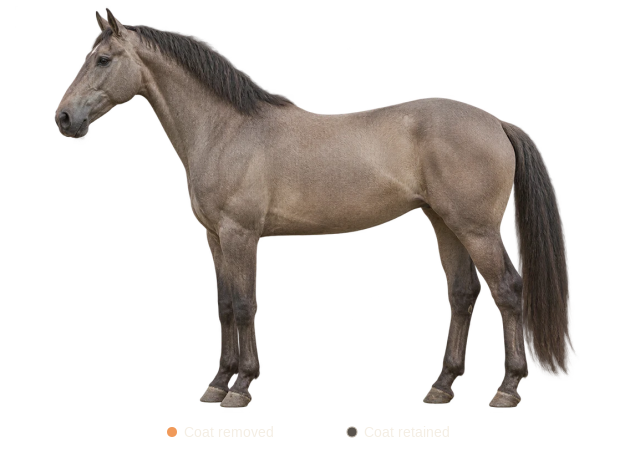
No coat needs to be removed on the information given. All of the natural coat remains.
A useful option when there is no sweat-management problem. Keep observing comfort as the coat grows.
Find a clipping pattern that suits your horse’s workload, sweating and living conditions.
Not sure whether your horse needs a bib clip, trace clip, blanket clip or something else? Answer a few quick questions about workload, sweating and turnout to explore which clipping pattern may be suitable.
Free to use. No account required.The interactive selector needs JavaScript. If it cannot load, you can still explore every clipping pattern and the guidance below.
Your clip suggestion
This tool provides general guidance to help you explore clipping options. The most suitable clip depends on your individual horse, and the result is not a substitute for experienced or veterinary advice.
Removing coat changes your horse’s natural insulation. RugWeather combines your horse’s profile with the local forecast to help you decide what protection may be useful as conditions change.
RugWeather currently records clipped or unclipped, rather than the precise clip pattern. This selector does not save a clip to your profile or change your rug recommendations.
Get My Free Rug RecommendationFree for one horse. No payment details required.
Start with a problem you can actually observe: where your horse sweats during normal work, how long the coat takes to dry and whether that is making exercise or care difficult. A horse clipping quiz can help organise those observations. It cannot inspect the coat, assess body condition or watch your horse working, so use the result as a starting point for a conversation at the yard.
Choose the least coat removal that deals with the sweaty areas. A thick-coated horse doing short hacks may need a different approach from a finer-coated horse doing the same work. Turnout, usable shelter and the checks you can arrange matter alongside exercise. Before choosing a larger pattern, ask who can adjust protection if the weather changes while you are away.
No. A comfortable horse that hardly sweats may not need a clip, including in winter. There is no reason to remove insulation simply because other horses on the yard are clipped. Reassess if workload changes or drying becomes difficult. Unexpected heavy sweating with little work deserves investigation rather than automatically reaching for the clippers.
These original diagrams show representative boundaries on the same horse outline. Orange marks coat removed; grey marks coat retained. Names and boundaries vary, particularly for trace and chaser clips. They are visual explanations, not templates to copy onto a horse.
No coat needs to be removed on the information given. All of the natural coat remains.
A useful option when there is no sweat-management problem. Keep observing comfort as the coat grows.
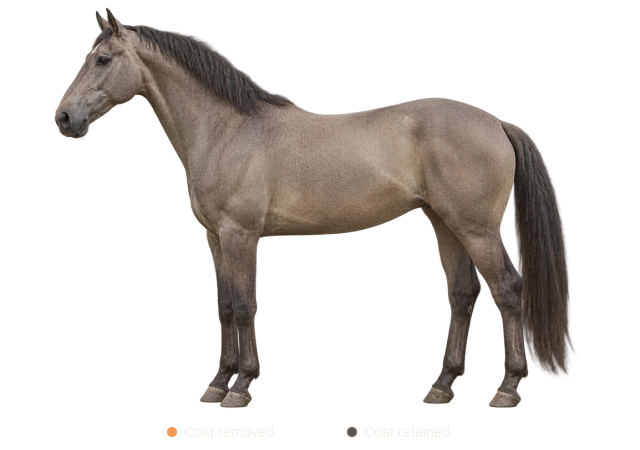
A small area of lower neck and chest. Most of the neck, body, back, quarters and legs.
A small starting pattern for local chest sweating, often considered for light work.
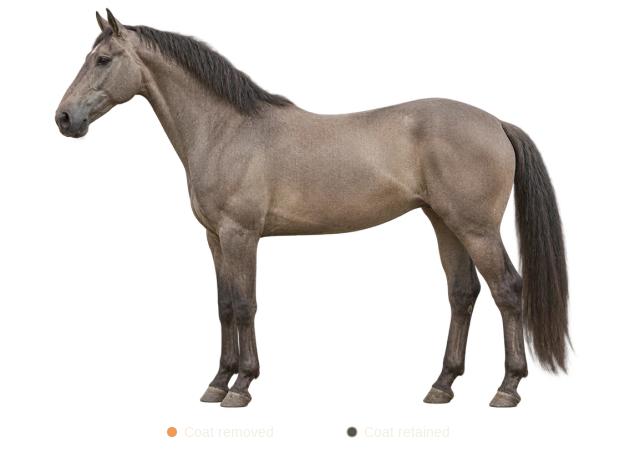
Lower neck, chest and part of the underside, with a diagonal boundary. The back, quarters, legs and much of the body.
The diagonal boundary can suit sweating around the front and underside without removing the quarter coat.
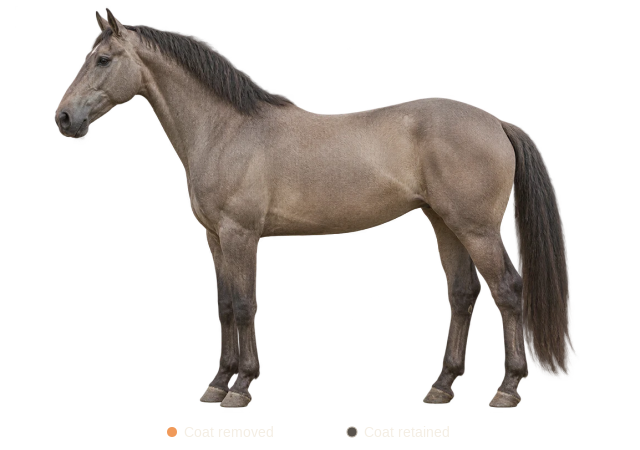
Lower neck, chest, belly and lower sides. The upper neck, back, quarters and legs.
A lower or higher line can be discussed to cover the actual sweat pattern; start conservatively where practical.
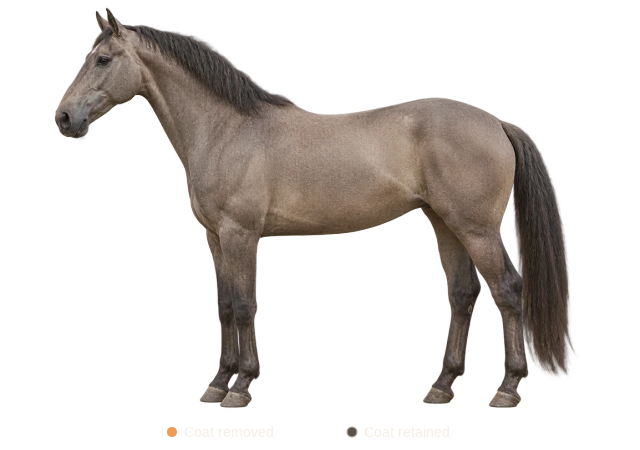
A larger area of lower neck, chest, belly and sides than a basic trace. A strip along the top of the neck, the back, upper quarters and legs.
This version retains the top of the neck and topline while exposing more of the sides than the basic trace shown.
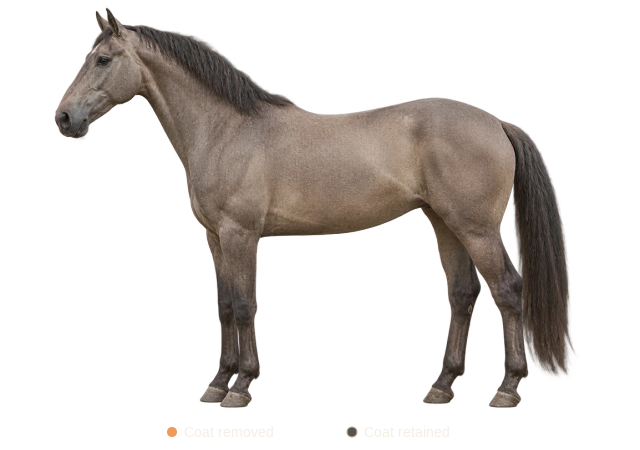
Neck, chest, belly and larger areas of the sides. A blanket-shaped area over the back and quarters, plus the legs.
Useful to discuss for broader sweating when regular aftercare is available. The retained back coat does not remove the need for checks.
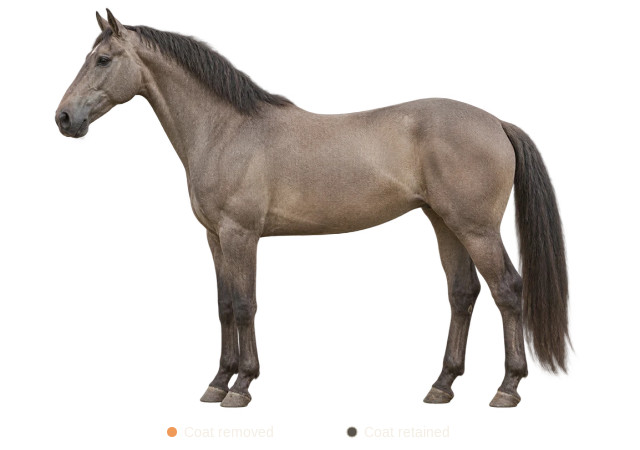
Most of the neck and body coat. The legs and a saddle-shaped patch; head treatment varies.
A broad pattern for demanding work where needed, with leg coat and a saddle patch left on. Care requirements increase.
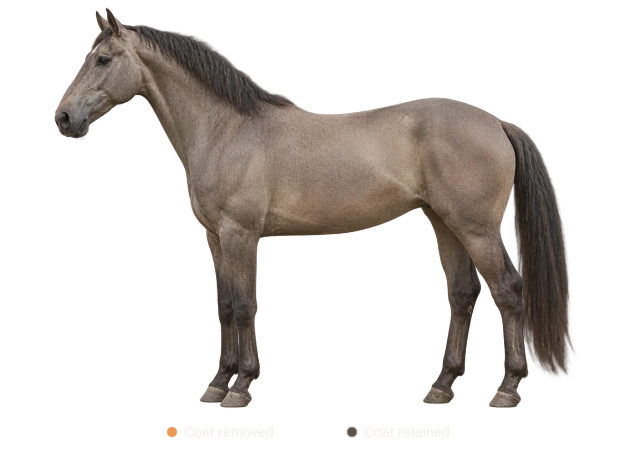
Almost all body and leg coat; head treatment needs particular care. Mane, tail and sensory hairs must remain; very little body insulation is retained.
A substantial loss of insulation, including leg coat. Consider only with a clear need and reliable management; retain sensory hairs.
A trace clip leaves a useful band of coat over the upper body. A chaser can extend the removal higher while retaining the upper neck and topline. Compare the proposed boundary with where your horse actually sweats, rather than relying on the pattern name alone. Your clipper may describe a similar boundary differently.
A full clip removes far more natural protection than either. Hard work does not automatically justify it: sweating, drying, shelter and care must support that decision. A blanket or hunter pattern may deal with the problem while leaving more coat. If widespread sweating conflicts with exposed turnout or limited aftercare, get help agreeing a management plan instead of assuming a tiny clip will be sufficient.
Allow time to prepare a clean, dry coat and a familiar, safe workspace. Check equipment and use an appropriate electrical safety setup. An experienced person should help if this is your first clip. Introduce the noise and sensation gradually, take breaks and check blade temperature regularly; hot blades should not touch the skin.
Stop if the horse is distressed, painful or difficult to handle safely. Do not force the situation. Health concerns, poor condition and medically directed clipping need veterinary input. Keep whiskers and inner-ear sensory hairs. Leave sensitive or difficult areas to someone with suitable experience. Our practical horse clipping guide covers preparation and a calm approach in more detail.
Removing coat changes insulation, but it does not create one correct rug weight. Consider the area removed, remaining coat, wind, rain, shelter, condition and access to forage. Check your horse rather than treating the thermometer as a switch. Too much insulation can cause discomfort as well as too little protection.
Inspect skin and comfort, keep track of drying after exercise and arrange checks when conditions change. Removing coat over the back may also affect protection needed during cold or wet exercise. Use our horse rug temperature chart as a broad starting point and the complete horse rugging guide for the wider decision. Neither replaces an individual assessment.
No clip may be needed if your horse hardly sweats. For local chest sweating, discuss a bib; if sweating extends to the girth and belly, an Irish or low trace may be worth considering. Match the boundary to the horse, turnout and care.
A basic trace removes lower neck, chest, belly and lower-side coat. A chaser often removes more from the sides while retaining the topline and upper neck. Names vary, so agree the actual line with your clipper.
Some can with an appropriate pattern, usable shelter and dependable checks and protection. Living out does not automatically rule out a small clip. Extensive sweating and very exposed conditions need an individual management discussion.
There is no single weight. Assess weather, exposure, condition, remaining coat and comfort. Check beneath rugs and adjust as conditions change; full clipping does not mean a heavyweight is always suitable.
When there is a practical coat-management need and safe handling and aftercare are in place. Timing and repeat clipping depend on coat growth and workload. Do not clip simply because a particular date has arrived.
Welfare guidance informs the general advice; pattern references inform the descriptions. The diagrams and decision tree are RugWeather’s own work. The selector has not been independently validated by an equine professional. Referencing these organisations does not imply endorsement.
Add RugWeather to your home screen so you can check rug recommendations quickly.
Your times are saved, but reminders are not enabled yet. Add RugWeather to your home screen, reopen the installed app, then finish notification setup there.
If no install option is available, use a browser that supports installed web apps.